
- Author: Kathy Keatley Garvey
Don't head over to the Bohart Museum of Entomology in the Academic Surge Building on Crocker Lane on Saturday, April 20 during the 110th annual UC Davis Picnic Day.
Why?
It will be closed.
The Bohart Museum, part of the UC Davis Department of Entomology and Nematology (ENT), will be staffing a pop-up tent from noon to 4 p.m. in front of Briggs Hall, home of the department.
That means all the "bug" displays at the 2024 UC Picnic Day will be at one place: Briggs Hall. The Bohart has provided a QR code and the location:
https://maps.app.goo.gl/DLBmhLuEnP1rWjn67.
Tabatha Yang, education and outreach coordinator, says the Bohart Museum is planning four areas of interest:
- The "Oh, my drawers," (California arachnids and wing diversity showcasing cicadas and California dogface butterflies.
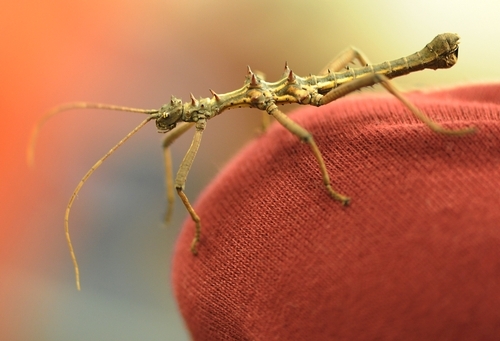
- Petting zoo of live insects (thorny sticks), which attendees can hold and photograph. Also shown will be a cicada nymph (from retired Bohart senior museum scientist Steve Heydon) and horntail caterpillars from UC Davis biology lab manager and UC Davis alumna Ivana Li.
- A Bohart poster giveaway--California dogface butterflies.
- A dogface butterfly face banner where attendees can pose for photos
The California dogface butterfly, Zerene eurydice, is California's state insect, as authorized by the State Legislature in 1972. The butterfly is found only in California, from the foothills of the Sierra Nevada to the Coast Ranges and from Sonoma south to San Diego. Its most prevalent habitat is in Auburn at the Placer Land Trust's private conservation site (which the public can see through specially guided tours). Why is it there? Because its larval host plant, false indigo (Amorpha californica) thrives there.
The male, which sports a yellow silhouette of a dog's head on its wings, is known as "the flying pansy." The female is mostly solid yellow except for a single black spot on its upper wings.

Kareofelas serves as a docent or volunteer tour guide for the Placer Land Trust's dogface butterfly site. He has reared--and photographed--a dogface butterfly from egg to adult. And he's also grown false indigo.
The posters to be given away Saturday--until gone--are the work of Kareofelas and Keller and depict the male and female butterfly.
Theme of the Bohart Museum's Picnic Day display is "Bonding with the Bohart," in reference to Professor Jason Bond, who succeeded UC Davis distinguished professor emerita Lynn Kimsey as director on Feb. 1. Kimsey served 34 years as the director. Although officially retired from the university, she continues to serve as a researcher, and as the executive director of the Bohart Museum Society and editor of the newsletter. Bond is the Evert and Marion Schlinger Endowed Chair of the Department of Entomology and Nematology, and the associate dean, UC Davis College of Agricultural and Environmental Sciences. He also serves as president-elect of the American Arachnological Society.

In addition to the Bohart Museum displays, the entomological events at Briggs Hall will include:
Bug Doctor
Briggs Hall Entryway
Graduate students will answer questions about insects. What's that bug? Attendees are encouraged to bring an insect or photo for identification.
Cockroach Races
Front of Briggs Hall
American cockroaches, Periplaneta americana, from Bob Kimsey's forensic lab, race on a specially made track, while roach fans cheer for their favorites. (Sometimes the athletes are named for faculty, friends or bystanders.
Medical Entomology
122 Briggs Hall
Carla-Cristina "CC" Melo Edwards of the Geoffrey Attardo lab is coordinating the medical entomology display. Her research focuses on investigating the physiological mechanisms underlying pyrethroid resistance in Aedes aegypti (the yellow fever mosquito).
Diversity of Arachnids
122 Briggs Hall
Doctoral student Emma Jochim of the Jason Bond lab is coordinating an exhibit she created last year to display the diversity of arachnids, such as vinegaroons, whip spiders, tarantulas, and scorpions. "We'll have live animals and fact sheets that will give a general overview of their diversity, behavior, and habitat," Jochim said. "I'll also bring some curated specimens to show what goes into creating a scientific collection and talk about why collections are important for understanding biodiversity. "
Maggot Art
Briggs Courtyard
Artists--children and adults alike--create maggot art by dipping a live maggot into water-based, non-toxic paint. It's suitable for framing (or at least a spot on the refrigerator door). This activity will close at 3.
Dr. Death
122 Briggs Hall
Forensic entomologist Robert Kimsey will display and discuss his work.
Entomology at UC Davis
122 Briggs Hall
Displays of insects, including bees, ants and more. Graduate students, faculty and emeriti will staff the tables.
Fly-Tying
Briggs Hall courtyard
Fly Fishers of Davis will show attendees how to tie a fly. The recipients take home the flies.
Insect-Themed T-Shirt Sales
Briggs Hall entryway
Members of the Entomology Graduate Student Association (EGSA), led by president Mia Lippey, will be selling their popular insect-themed t-shirts, including The Beetles.
Mosquito Control Booth
Entrance to Briggs (below front steps)
Sacramento-Yolo Mosquito and Vector Control District will be providing information on mosquitoes, answering questions, and offering give-a-ways.
UC Statewide Integrated Pest Management (UC IPM)
Briggs Hall Courtyard
“We plan to have many of our usual materials on display and will be giving out the live lady beetles (aka ladybugs) again,” said urban and community IPM educator Lauren Fordyce. “We purchase them from a local garden center. In addition to that, we plan to have a prize wheel that adults and kids can spin, answer a question, and win a prize if they answer correctly. We may also have temporary insect tattoos to give away.”

- Author: Kathy Keatley Garvey

The UC Davis Department of Entomology and Nematology will not only celebrate insect and nematode diversity at Briggs Hall during the 110th annual UC Davis Picnic Day on Saturday, April 20, but also "The Diversity of Arachnids."
Doctoral student Emma "Em" Jochim of the Jason Bond lab is coordinating an exhibit she created last year to display the diversity of arachnids, such as vinegaroons, whip spiders, tarantulas, and scorpions.
"We'll have live animals and fact sheets that will give a general overview of their diversity, behavior, and habitat," Jochim points out. "I'll also bring some curated specimens to show what goes into creating a scientific collection and talk about why collections are important for understanding biodiversity."
Emma holds a bachelor's degree in biology, with a minor in geology and chemistry, from Millsaps College, Jackson, Miss., where she graduated summa cum laude. Her honors thesis: "Species Delimitation of Vaejovis Scorpions from the Santa Catalina Mountains Using Genetic, Morphological, and Geographical Data." While a student at Millsaps College, her outreach activities including sharing her knowledge of tarantulas, scorpions and vinegaroons at the Mississippi Museum of Natural Science.
At UC Davis, her advisor is Professor Jason Bond, the Evert and Marion Schlinger Endowed Chair of the Department of Entomology and Nematology; the director of the Bohart Museum of Entomology; and associate dean, UC Davis College of Agricultural and Environmental Sciences. He's also the president-elect of the American Arachnological Society.
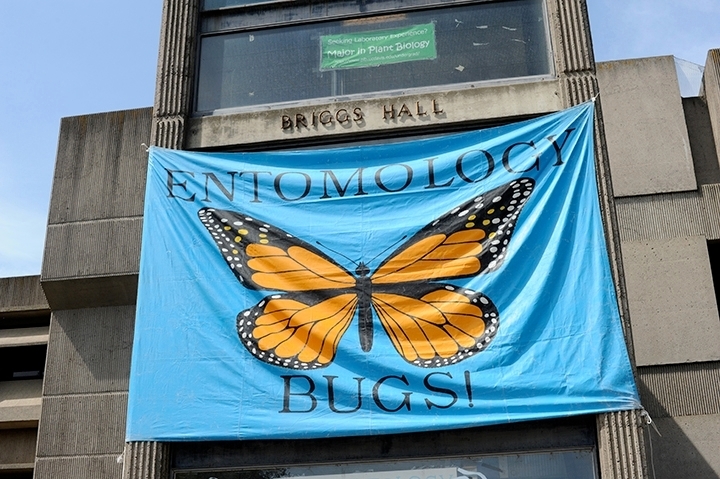
What can you see at Briggs Hall during UC Davis Picnic Day? Cockroach races, maggot art, walking sticks, flies, ants, bees, nematodes, beetles, butterflies, mosquitoes and more. The UC Davis Entomology Graduate Student Association will be selling insect-themed T-shirts. (See news story)
Most Briggs Hall events are from 9 a.m. to 5 p.m., announced the co-chairs, doctoral student Grace Horne and forensic entomologist Robert Kimsey. This year the Bohart Museum of Entomology, part of the Department of Entomology and Nematology, will staff a pop-up tent in front of Briggs from noon to 4 p.m. The theme: "Bonding with the Bohart." Visitors can hold walking sticks and Madagascar hissing cockroaches from the Bohart's live petting zoo, and see insect specimens, including butterflies, bees, beetles and dragonflies. (The Academic Surge Building, home of the Bohart Museum, will be closed on Picnic Day).


- Author: Kathy Keatley Garvey
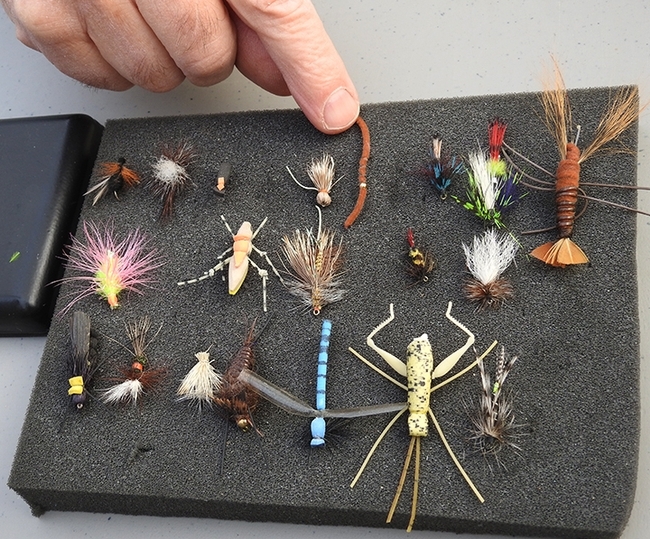
Ever seen an angler tie a fly?
You will if you visit Briggs Hall during the 110th annual UC Davis Picnic Day on Saturday, April 20.
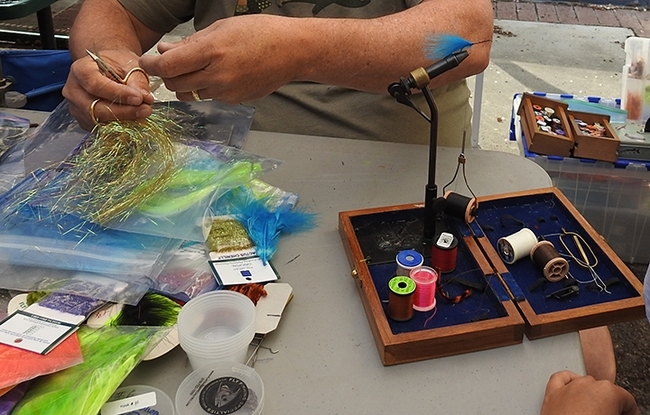
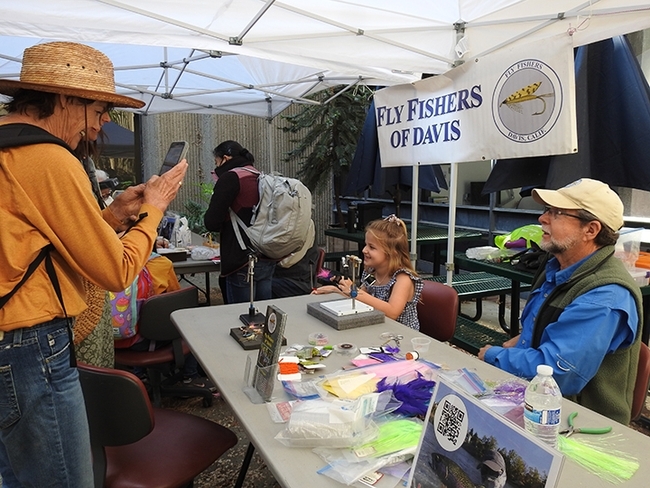
"The Art of Fly Tying" by the Fly Fishers of Davis is an integral part of the insect events and activities at Briggs Hall, home of the UC Davis Department of Entomology and Nematology.
The anglers are eager to show you how to tie a fly and then gift it to you.
At the 2022 UC Davis Picnic Day, we remember veteran fly fisherman Paul Berliner asking a six-year-old girl if she'd like a fly tied for her.
She wasn't sure at first, but when she saw the neon pink feather, she was hooked. She loves pink.
The Fishers of Davis is a "non-profit organization with 100+ members from communities in the central Sacramento valley," the website indicates. "Our charter is to promote the art of fly-fishing and to protect our natural resources and fisheries through community education and conservation. FFD is an affiliate of the Federation of Fly Fishers (FFF), an international non-profit organization and its Northern California Council (NCCFFF). Our meetings and membership are open to the public, and we provide equal opportunity membership without any discrimination."
During the COVID pandemic and the cancellation of UC Davis Picnic Day, many organizations went virtual with presentations. The Fly Fishers created a video (click here), narrated by Berliner that won a second-place award in the UC Davis Picnic Day's Blue and Gold category, spotlighting health, recreation and athletics. Also check out Berliner's videos on YouTube)
The Fly Fisher meetings, open to the public, are held the last Tuesday of each month, with a social at 7 and the general meeting at 7:30. (See website for details). All members receive the club's monthly newsletter, “The Fisherman's Line.” See the Newsletters for the current edition and back editions. Yearly dues for adults and families are $30 per year. Yearly dues for students are $15 per year.
Typical meetings include the following:
- An introduction of new members, and reports on who has been fishing.
- A guest speaker who narrates a presentation covering some aspect of fly-fishing or conservation.
- An available library of books and videos for members to sign out.
- Updates on where to fish, club activities, outings, and conservation projects.
Outings take them to such fly-fishing sites as Pyramid Lake, Lake Berryessa, McCloud River, Lake Davis and Trinity River and more.
"Do our members ever get skunked on a fishing trip?" is one of the questions posted on the website. The answer: "Never! (Though, as highly trained professionals, we never admit it.)"
For other insect-related activities at Briggs Hall during the UC Davis Picnic Day, click here.

- Author: Kathy Keatley Garvey
When the UC Davis Department of Entomology and Nematology hosts its "bug activities" at Briggs Hall during the 110th annual UC Davis Picnic Day on Saturday, April 20, one of the most popular is maggot art.
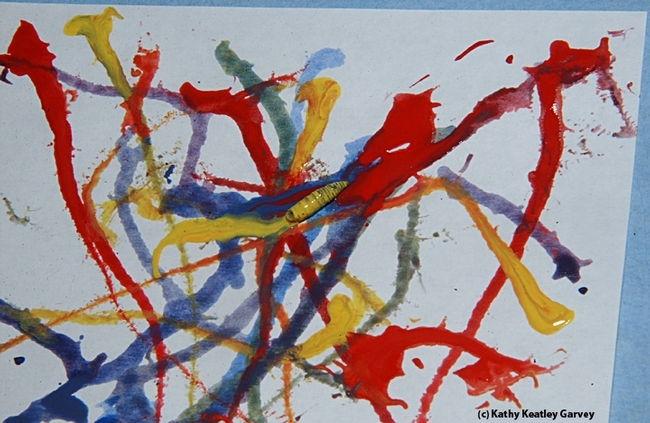
Children and adults alike create maggot art by using plastic forceps to dip a live maggot into water-based, non-toxic paint. They then watch it--or guide it--to make the drawing they're seeking.
The result: It's suitable for framing (or at least a spot on the refrigerator door).
Rebecca O'Flaherty, a former graduate student of UC Davis forensic entomologist Robert "Bob" Kimsey, coined the educational teaching curriculum, "Maggot Art," back in 2001 when she was studying at the University of Hawaii and rearing blowflies for her forensic research.
Then, asked to create an activity to draw the interest of elementary school students, she came up with "Maggot Art." She also wanted a way to generate interest and respect for forensic entomology,
It quickly drew national interest. The CSI television show featured one of her works, “Ancient Offering,” which hung on the permanent set in Gil Grissom's office. O'Flaherty also exhibited her work at art shows, including a two-month exhibition at the Capital Athletic Club, Sacramento, in 2007.
Today, maggot art activities occur sporadically throughout the country. The Entomological Society of America acknowledged O'Flaherty here. "The basic premise is dipping prepuparial blow fly larvae (Diptera: Calliphoridae) into non-toxic ink and then placing them on a piece of paper or file card and letting them crawl around to create an abstract picture. Different larvae are used in different colours to create the picture. Rebecca O'Flaherty first demonstrated this at a North American Forensic Entomology Association Meeting many years ago, and it is a popular activity and many youtubes can be viewed to see how it works."
Sometimes the young artists get quite attached to a maggot and ask an event coordinator or parent if they can take it home. (Nobody ever gets a "yes!")
(For a complete list of bug activities at Briggs Hall, see the UC Davis Entomology and Nematology website. This year the Bohart Museum of Entomology display and live petting zoo also will be at Briggs. The Bohart headquarters in the Academic Surge Building will be closed on Picnic Day)

- Author: Kathy Keatley Garvey
Remember when San Francisco 49'ers wide receiver Brandon Aiyuk credited his spectacular 51-yard catch in the 2024 NFC championship game with the Detroit Lions to a ladybug (note that entomologists correctly call it a "lady beetle") landing on his shoe before the game?
Well, those attending the 110th annual UC Davis Picnic Day activities on Saturday, April 20 at Briggs Hall--home of the UC Davis Department of Entomology and Nematology--can also net some luck.
Children are encouraged to take home a couple of the beetles at the UC Statewide Integrated Pest Management Program (UC IPM) booth in the courtyard of Briggs. (Adults can do so, too. Maybe they'll name their beetles "Brandon" and "Aiyuk.")
The ladybug is actually a beetle (Coleoptera), not a bug (Hemiptera). It's associated with good luck because it eats the aphids that try to destroy our crops. It can eat as many as 5000 aphids in its lifetime, scientists estimate.
"These beetles have become a cultural icon of sorts because of their appearance and their beneficial habits," writes UC Davis distinguished professor Lynn Kimsey, former director of the Bohart Museum of Entomology, in her insect fact sheet on lady beetles. "Both adults and larvae feed on aphids and other small, soft-bodied insects...They are ferocious predators on small insects." (See what the UC Statewide Integrated Pest Management Program says about lady beetles.)
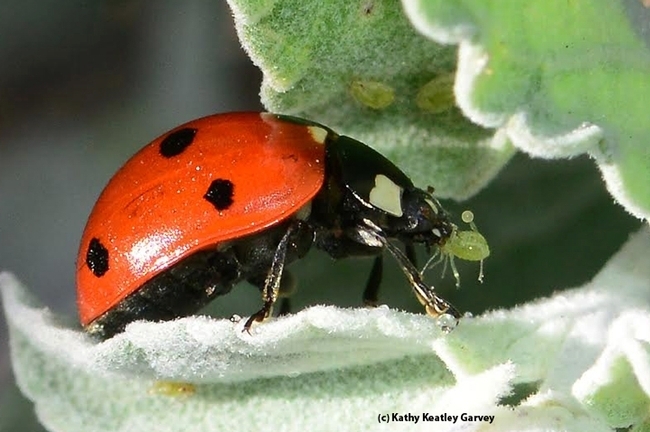
Ever seen a close-up shot of a lady beetle eating an aphid? The predator and the prey...
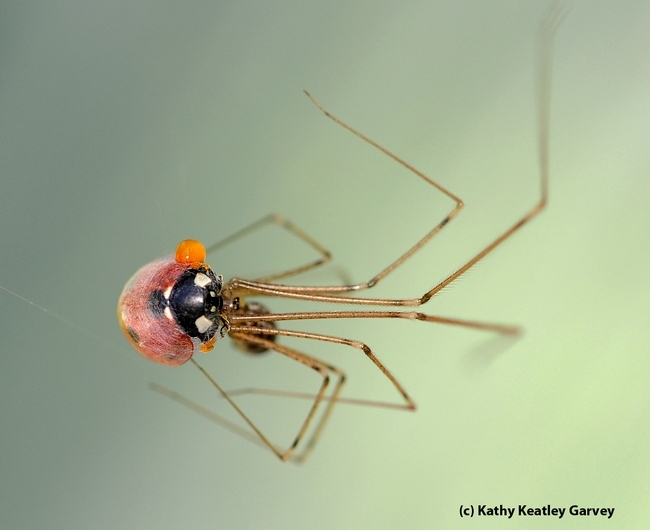
Ever seen a cellar spider snaring and eating a lady beetle? The predator and the predator...one becomes prey.
Ordinarily, the lady beetle's bright red coloration serves as a "warning" to predators. Plus, lady beetles are known to ooze a foul-tasting chemical that tastes so bad that predators leave them alone. This lady beetle engaged in "reflex bleeding," exuding an alkaloid toxin (which did not deter the predator).
Lady beetles will be just a few of the bugs at Briggs Hall during UC Davis Picnic Day. You'll also see cockroach races, maggot art, and displays featuring ants, bees, walking sticks, mosquitoes, nematodes, butterflies, spiders, whip scorpions, and more. Check out "bug" activities at Briggs Hall here. UC Davis Picnic Day is free and family friendly.